
Summary
of the Final Cut process of extractions can be located on
the latest news page by clicking here
Over
the years we have been asked many questions about extraction
methods and extracts. I have put this explanation together
to answer those questions.
I have also added a brief explantion that leads to the reasoning
behind our new method of extraction along with the design
of the equipment that we had to develop to make it all happen..
We
DO NOT carry Crude Extracts. Crude and Regular Extracts
are weaker and contain inconsistent amounts of Salvinorin-A.
Neither do we carry Standardized Extracts. We have developed
a special method and equipment so that you can get the quality
of standardized and the strength of crude. This may sound
like absurd statements but read all the way through to fully
understand the reasoning.
WHAT
EXACTLY IS A STANDARDIZED EXTRACT AND A CRUDE EXTRACT?
Standardized
extractions have grown in popularity because of the garage
type labs and home based extraction procedures. They were
inefficient and easy to do, They crude extractors cut corners
to save time and money.
Because of the loss of salvinorin A and low quality due
to various methods customers began to demand that they get
a standardized amount
of salvinorin A deposited on the leaf to ensure they are
getting what they pay for.
A standardized extract is one in
which the active compound - in this case salvinorin-A -
is extracted from the plant and isolated, weighed and then
redeposited back onto the dried leaves at a specific amount.
In the case of Salvia extracts 2.4 milligrams is considered
the standard-ized amount to assume a gram of salvia leaf
contains. Therefore if you want to enhance the leaf to 10X
you would add 24 milligrams back onto dried, ground up leaf
material. The standard average amount was conceived of ??
by ??. Not sure but I am sure that the quality of leaves
has only gotten better. At this point in time if one were
to assume this standard to be correct then you would be
with left over salvinorin A crystal after you placed the
amount back onto the leaves.
We found that to be the case.
Therefore we stopped standardizing extract shortly after.

This photo was taken in a series of photos
of an extraction performed by
Christopher Hazlitt
Pure crystalline salvinorin-A is a very rare compound that
few people have ever seen and even fewer people have ever
produced. Almost all the other salvia extracts on the market
are crude extracts because of the complexity, time and expense
you have to shell out to isolate a chemical. It involves
a series of washes involving two chemicals. One polarity
of one chemical attracts the desired salvinorin A. While
the other polarity of the other chemical attracts the undesired
lipids. This mixture is allowed to separate into two layers.
The layers are separated into two parts and the process
continues up to five times to ensure that all the salvinorin
A is ripped from the lipids. The lipids are discarded each
time. That means that you are throwing away some of the
salvinorin A. The system is not perfect. As a matter of
fact you will loose from 20% to 40% depending upon how well
you do your job.
I wonder if it is this stage that the average of 2.4
milligrams was discovered.
The remaining chemical that now contains the salvinorin
A is set into motion to allow the chemical to crystalize.
Using temperature variations can aid and speed the process
but for the most part time is your friend. Sometimes it
begins to happen immediately. This process as stated above
is time consuming and expensive. The chemicals such as hexane
and methanol as well as naptha are very expensive and hard
to locate. These are the chemicals that are used to wash
and isolate the salvia molecule.
Basically to only deposit some of the salvinorin A on the
leaf requires an additional step of purification (isolation)
and those steps of isolation will incur additional cost
and will produce a weaker extract because of the loss during
washing and separation.
This is what ends up happening when you wash and weigh and
wash and weigh until you get a pure isolated chemical.
Crude
extracts
are made by soaking the leaves in a variety of solvents
to dissolve the salvinorin-A out of the leaves. The trouble
with this is that a lot more than just the Salvinorin A
gets dissolved out of the leaves, much of the plant lipids
(fat, oil, wax and tar ) get dissolved in the solvent as
well and end up in the extract and subsequently in your
lungs.
Not to mention sticky extract is hard to put in a vial or
baggie.

This is a large coffee filter that is being
discarded after it was used to filter out a 2 kilo ethanol
extraction of salvia divinorum. The lipid weight came out
to be 75 grams. And this was just the amount we could filter
out after freezingto 20F degrees below zero. These were
the early days of extracting. Luckily only 5x was being
made.
This
ancient extraction method ensures that you get all of the
Salvinorin-A out but only if the method that was incorporated
was well done and efficient. Acetone, mild heat and time
is good at this point. Remember that heat gets more unwanted
lipids out but also remember that a large portion of the
salvinorin A molecule resides in the lipids and is virtually
inseparable.
Some
Popular Solvents
Acetone extractions are the most efficient means of extraction
for most botanicals. Most certainly for salvia extracts.
The polarities of the Salvinroin-A molecule and the Acetone
molecule are perfectly matched. They attract like magnets.
But so do the lipids. The leaves are literally leached of
everything. They are pale in color after the extraction
process. All life is removed and now rest in a pool of acetone
waiting to be dealt with.
Ethanol or Alcohol extractions are also used but are less
efficient and seem to take just as much lipids out as well
as putting them into an unmanageable gunky state. Ethanol
cost much more than Acetone and does not seem to pull as
much salvinorin out according to HPLC testing. Not with
this method we use anyway. Some people mix acetone and ethanol
together hoping for better results.
I have heard of many concerns with actone extractions
that moves me to add this statement.
Although I do not use acetone for extractions I think it
would be good to clear this up.
During
the pouring and drying of the extracts at 175F, the chemicals
are evaporated with such efficiency that none of the solvent
remains to be weighed with the most sensitive scales.
The resulting extract is completely clean of solvents.
But the end result is usually dirty and sticky with lipids
unless you perform extensive and time consuming washes before
applying the extraction to the the ground leaves.
|
This
seemed to be manageable for a while. As long as you were
only making 5X and 10X. But the wet nature
of the fats waxes and oils degraded the quality of the smoke.
As the market grew to desire stronger extracts such as 15X
and 20X it became harder and harder to make extractions
that were clean and lipid free.
With the higher strengths more lipids and Salvinorin-A were
poured onto fewer leaves to make extracts stronger. This
meant very sticky and dirty extracts if crude methods were
used. It also meant more cost if you wanted to clean it
up. Standardized extracts started looking like the only
way to go. There
are many roads to standardization. And some are not too
healty for the consumer.
Crude extracts were not marketable at all in this new stronger
form of 20X extract.
As you can see from the picture below this crude extraction
is very sticky. And after you pour 50 grams of this onto
50 grams of leaves to make 100 grams of extract it is still
not diluted enough with leaves to be tolerable.
The lipids that can be expected from a single kilo extraction
can range as high as 75-100 grams of just lipids alone.
Dependant on the quality of the leaves and the solvent and
the temperature and time the process is allowed to run.
Enough
about Crude methods
A
new method had to be developed or adopted that would eliminate
the expensive steps of the isolation and standardized methods
and at the same time keep the lipids ratio to salvinorin
A to a minimum while still providing a strong extraction
such as found in a crude extraction methods.
We have developed that method.
OUR METHOD OF EXTRACTION
We do not provide Standardization for extractions nor do
we use acetone or ethanol as solvents.
We have eliminated that step and those solvents from the
process with the method and equipment we developed and now
use.
There is no need to standardize and charge for the process
if the process is repeatable. You just do it once and then
you eliminate that step. After you have isolated the Salvinorin-A
and then weighed and measured it and you find that the end
result is the same every time then you can safely eliminate
the isolation, weighing and measuring phase. This saves
you money and saves you time as well. Even if you are paying
for it it is probably not being performed.
Do you taste your tea for strength every time. No, you know
what a teaspoon will produce.
With
our method we know that we will get 99% of the Salvinorin-A
out of the leaves and onto the final extract or enhanced
leaves. The only thing we need to know is how much salvinorin
A is in the leaves to start with. This can be performed
with one test and it is performed with each new shipment
of leaves from a new supplier. The leaves from any supplier
may change as much as a half milligram. But from shipment
to shipment from the same supplier they do not change much
at all if any. Once a good supply of leaves are found we
stick with it.
Up to 3 milligrams of Salvinorin-A can be expected from
a top quality supplier. If any more than that is claimed,
then it is most likely not a true claim or they are being
misled.
After
years of testing and working with various solvents and equipment
we have discovered and developed a method of extraction
that will revolutionize the industry.

Notice how clean the above extracton looks compared to crude
methods as pictured above this picture. You can also get
an idea of the temperature required to accomplish this if
you notice the frost that immediately accumulated on the
glass after exposing it to the humid air.
99% of all the Salvinorin-A in the leaves was pulled out
from the leaves and retained in this 200 gram test using
our new method and equipment. More than any other standardized
isolation/wash of the same amount of salvia leaves.
Only an HPLC matched these results.
In other words this new method could be used to check for
Savlinorin-A quantity as accurately as an HPLC analysis.
This new method of extraction economically and efficiently
produces much higher quality and stronger extracts and maintains
a totally clean waste free extract, all in one extraction
process, with the least loss of salvinorin A - of any other
method bar none. We do this with no heat applied to the
extraction or leaves. And the entire process take less than
1 hour per 2.5 kilo extraction.
Basically we have discovered how to extract from the leaf
material and the lipids in one process.
By using a special formula of solvents along with temperature,
pressure and time we can control exactly what and when we
will pull out any chemical from just about any material.
We have tested each and every process over the years. The
resulting data has been duplicated over and over until we
finally began the final deveolpment of our design and extraction
equipment. Our final design is now complete and running
beautiflly. We call it "The Final Cut"
We borrowed some ideas of the supercritical extractors and
incorpoated knowledge and data we gathered over the years
to build a totally new extractor.
WE did not cut corners, we eliminated them.
That was our goal for the past two years.
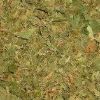
In the picture above you
can not help but notice the Salvinorin-A cyrstals adhering
to the outside of these flakes of salvia leaf.
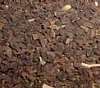
This is 20X extract produced with
the Final Cut process that we have developed and refined
over the past 3 years.
As you can see, the extract is void of all waxes, fats and
oils. This is verified by the pure white crystals of Salvinorin-A
that crystallized onto the outside of the leaf as the extract
cooled down during the drying time.
I think when you receive your extraction order you will
no longer be concerned
with standardized extracts and ethanol or acetone extractions.
We have spent the last 3 years designing and building equipment
and processes that are specially designed to suit your needs.
BUY
SALVIA EXTRACTS
BUY
SALVIA LEAF
(Lipids
are a large class of organic substances, insoluble in water
and greasy to the touch, including the fats, waxes, oils
and sterols.) |